IRON NEST: Heavy Turret Simulator IRON NEST Systems
Every dial, lever, and consequence that turns orders into artillery fire.
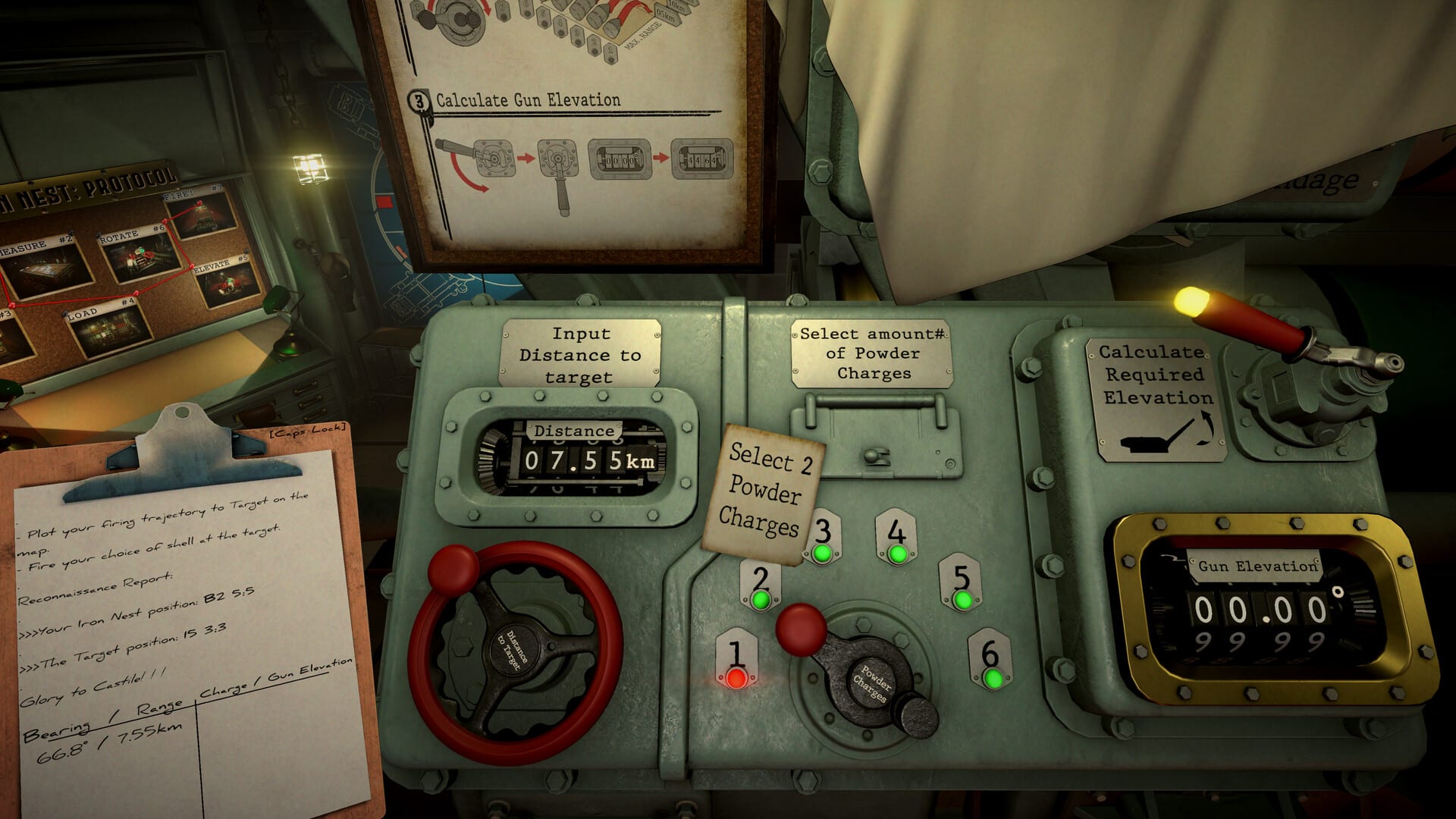
IRON NEST: Heavy Turret Simulator is built around systems, not reflexes. You do not sprint across a map or swap loadouts mid-fight —you stay inside a colossal dieselpunk turret and operate it like a machine with a job. This hub collects every major mechanic that sits between High Command and the shell leaving the barrel.
If you are brand new, start with Getting Started and then walk through a single shot in the first firing solution guide. Once the rhythm makes sense, come back here for the deeper layers that the demo only hints at.
The core firing loop
Every accurate round follows the same chain: intel —measure —calculate —load —fire. Orders arrive through the teleprinter and radio net. You turn coordinates into a plotted target on the tactical map, feed range into the ballistic calculator, choose shell and propellant charge, traverse and elevate the gun by hand, then commit the shot through fire control. Misses are corrected from recon reports, not guesswork.
Our dedicated fire control loop guide breaks each step down with common failure points —garbled orders, wrong origin on the map, mismatched shell type, or firing before the hydraulic traverse finishes. That page is the mechanical heart of the wiki.
Progression: abilities and ammunition
The free demo teaches the loop with a limited toolkit. The full campaign expands it with roughly 20 unlockable abilities and 30 ammunition types, widening what your crew and turret can do as Spain fractures around you. Abilities might speed hydraulic work, improve map readouts, or help you manage dual barrels under time pressure; ammo unlocks give you the right tool for armor, infantry, smoke screens, and harder targets.
See progression and abilities for how unlocks layer onto missions and requisition, and cross-check shell roles in our ammunition coverage when planning loadouts.
Narrative systems: orders and newspapers
Mechanics alone do not define IRON NEST. High Command sends orders, but the chain ends at your fingertips —you decide what to prioritize, what to delay, and what to refuse. After missions, newspaper front pages summarize the human cost of your fire: civilian headlines, military bulletins, and propaganda that reflect choices you made under imperfect information.
That consequence layer is not a separate minigame; it grows out of how you used the same firing loop on real targets. Read newspaper consequences before you assume every marked coordinate deserves a shell.
How systems connect to maps and updates
Map work is not a side feature —it is step two of the loop. The tactical grid guide explains squares, tokens, rulers, and plotting accuracy; the campaign regions overview shows how fifteen alternate-history Spanish theaters change what you measure and what you are asked to destroy.
For launch timing, demo access, and PC specs, see the updates hub —especially release date, demo download, and system requirements. If you want a opinionated take on whether the systems land, our review sums up demo reception and full-game expectations.
Recommended reading order
- Fire control loop —master the procedure first.
- Tactical grid —map tools that feed the calculator.
- Progression and abilities —what opens up after the tutorial.
- Newspaper consequences —why accuracy is not the only metric.
Operators who treat the turret as one integrated machine —intel desk, map table, calculator, loader, and guns —finish missions faster and with fewer wasted shells. That is the through-line every page in this hub shares.
Frequently Asked Questions
Quick answers to the most common questions.
What is the main gameplay loop in IRON NEST?
Intel from the teleprinter, map measurement, ballistic calculation, manual loading and gunlaying, then fire and correction from recon. See the fire control loop page for the full chain.
Do abilities change how the turret handles?
Yes. The full game adds around 20 unlockable abilities that expand crew and machine capabilities alongside 30 ammo types. The demo uses a smaller subset.
Are newspaper reports just flavor text?
They reflect mission outcomes and moral choices tied to what you fired on and which orders you followed. They are a consequence system, not decoration.